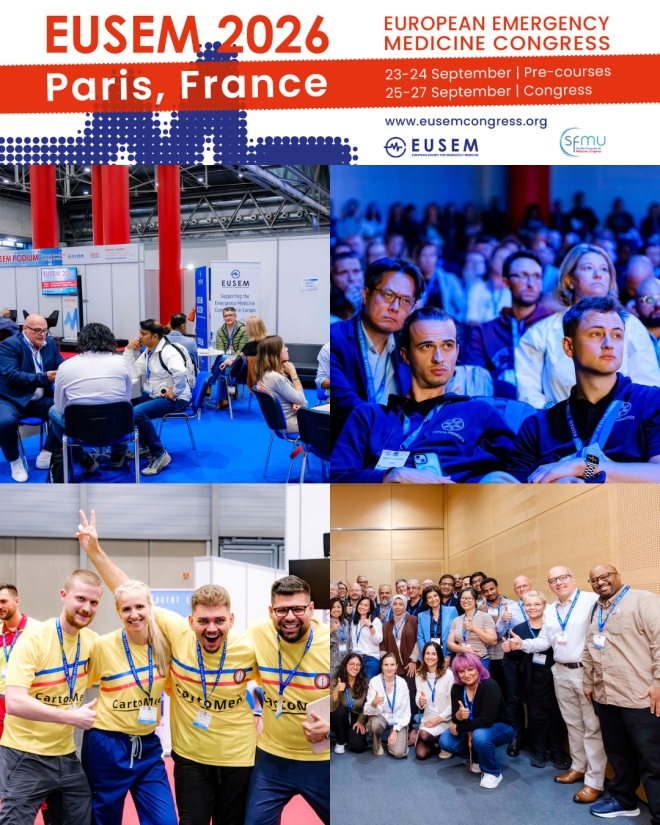
Quarterly EJEM Research Round-up
Welcome to the quarterly EJEM research round-up, where we present our top picks from the last three months of EJEM editions.
Barbra Backus
Welcome to the quarterly EJEM research round-up, where we present our top picks from the last three months of EJEM editions.
Barbra Backus
EUSEM would like to express its sincere support and compassion to all affected by the recent floods in Spain. We extend to those who have lost a loved one and for those injured, our sincerest sympathy. The survivors are now faced with the enormous challenge of clean up, and while doing so, even possibly exposing themselves to disease. We acknowledge the excellent, dedicated, and altruistic work that the rescue teams, our colleagues in the emergency rooms (doctors, nurses, and assistants) and the Spanish citizens are accomplishing despite very difficult conditions. EUSEM stands ready, alongside the Sociedad Española de Medicina de Urgencias y Emergencias to offer them assistance and support in a way that they would judge as being the most useful and most adapted to their needs. We recognize that this is a grueling and distressing time for the entire country, and our thoughts and prayers are with Spain.
END
Much has been achieved in European emergency medicine (EM) over the past 30 years since EUSEM was founded in 1994 at a meeting of the International Federation for Emergency Medicine in London.
Before the Society was launched there was no specialty in EM in Europe, let alone a core curriculum in the subject. Now, the Society has grown from a small, multidisciplinary group of individual experts into an organisation that has 38 national European societies, over 1200 individual members and represents over 40,000 EM specialists in Europe.
President of EUSEM, Jim Connolly, a consultant in EM at Great North Trauma and Emergency Care, Newcastle-upon-Tyne, UK, says: “Thirty is a real ‘coming of age’ moment for EUSEM and something we need to celebrate throughout the congress.
“When EUSEM was founded, the existence of EM as a primary specialty across Europe was seen as key to making emergency care the best it could be. This aim is now tangibly close and EUSEM needs to look at the next phase of EM development, including improved harmonisation and advocacy for the specialty and those who work in it.”
Emeritus Professor of Emergency Medicine, Dr Herman Delooz, of KU Leuven, Belgium, was instrumental in setting up EUSEM and became its first president. He says: “Both EUSEM and the European Journal of Emergency Medicine, which started in 1993 and was adopted as its journal by EUSEM at its foundation, have done very well. The specialty of emergency medicine is established in many European countries and the journal has achieved an international reputation.
“At the first European Congress on Emergency Medicine in San Marino, Italy, in 1998, we discussed and finalised a ‘Manifesto for Emergency Medicine in Europe’, which was published in the European Journal of Emergency Medicine that year. This Manifesto was translated in several European languages and was the European ‘coming of age’ of the Society. Following the publication, we were invited to lecture all over Europe by the national societies that represented emergency doctors.”
A significant milestone came in 2011 when, after lobbying from EUSEM, the UEMS (Union Européenne des Médecins Spécialistes), a non-governmental organisation representing national associations of medical specialists in Europe, recognised EM as a specialty.
EUSEM prepared a curriculum for the specialty and the latest version was published in 2019, in association with the UEMS Multidisciplinary joint Committee on Emergency Medicine. So far, 17 European national societies have implemented the curriculum in their countries.
Prof. Delooz says there is still more work to be done. “More research is needed to establish EM as an academic discipline.”
Mr Connolly says: “EUSEM is entering an exciting stage in its ‘coming of age’. Keys to the next stages of growth are developing a strong governance framework and a long-term strategy that engages all of the membership.
END
During the General Assembly on 15 October 2024, Dr Jim Connolly handed over his presidency to Dr Robert Leach. EUSEM would like to thank Dr Connolly for his leadership and support. He has ensured that the society will continue to grow. We welcome Dr Robert Leach as the new president.
PRESS RELEASE
Embargo: 00.01 hrs CEST on Wednesday 16 October 2024
Seizures caused by children swallowing medications or illegal substances doubled over 15-year period
Copenhagen, Denmark: New data shows that the number of children suffering a seizure after swallowing medications or illegal substances has doubled between 2009 and 2023 in the US. The findings were presented today (Wednesday) at the European Emergency Medicine Congress.
The most common substances involved in these poisonings include over-the-counter antihistamines, prescription antidepressants and painkillers, and illegal synthetic cannabinoids.
Dr Conner McDonald from the University of Virginia School of Medicine told the Congress: “Seizure is one of the most severe symptoms a poisoned patient can experience, and children are particularly vulnerable. Depending on variables such as where a seizure happens, how long it continues and the pre-existing health of the child, seizures can lead to long-term damage or even death.”
Working with Professor Christopher Holstege, Chief of the Division of Medical Toxicology at the University of Virginia School of Medicine, and colleagues, Dr Farah gathered data from the US National Poison Data System on seizures in children and teenagers (under the age of 20 years) that resulted from exposure to any single substance between 1 January 2009 and 31 December 2023.
The National Poison Data System brings together information from the 55 poison centres across the US. These centres are consulted in the most serious cases of poisoning, including poisoning in children that results in seizure.
The researchers analysed the data according to the children’s ages and the substance they had consumed. Overall, they found that cases had increased from 1,418 in 2009 to 2,749 in 2023, corresponding with an average yearly increase of five per cent.
Among children aged between six and 19 years, the number of cases had doubled over the 15-year period. In children under six years, there was a 45% increase in cases over the 15-year period.
The substances responsible for most of this increase include diphenhydramine (an over-the-counter antihistamine commonly used for allergies, hay fever and nasal congestions), tramadol (an opioid prescribed for pain in adults), bupropion (an antidepressant prescribed for adults and children), and synthetic cannabinoids known as K2 or spice (illegal substances that are man-made and chemically similar to substances found in the cannabis plant).
Dr McDonald explained: “Diphenhydramine can be purchased in the United States in bottles containing 500 or 600 tablets. Bupropion is being more frequently prescribed to treat depression in adults and children. Other legal and illegal drugs can be bought online and shipped around the world. Therefore, these drugs are becoming more available in homes and within the reach of children.”
Speaking before the Congress, Professor Holstege said: “The increase in seizures in children exposed to these drugs is extremely worrying and must be addressed. It’s a stark reminder to parents and carers to store medications safely so that children cannot get hold of them.
“In the US, we also need to have a serious discussion on whether products like diphenhydramine should be sold in containers with such large quantities of pills and whether these products should be contained within blister packs to make it more difficult for children and suicidal individuals to gain access to such a large quantity.”
Dr Barbra Backus is chair of the EUSEM abstract selection committee. She is an emergency physician in Rotterdam, The Netherlands, and was not involved with the research. She said: “The increase in drug poisoning among children is worrysome. Although these data are for the US, we know that drugs are the most common sources of poisoning in children around the world. It is important that we keep looking for safer distribution and storage of medication. Blister packs and child-resistant pill bottles can help, but all drugs, whether they are over the counter, prescribed, or illegal should be kept out of reach or locked away where children cannot access them.
“No parent or carer ever wants to see their child suffer a drug-induced seizure, especially when it could have been prevented.”
(ends)
[1] Abstract no: OA098, “Seizures in Single Substance Pediatric Exposures: Analysis from the United States National Poison Data System” by Conner McDonald, in the Oral Abstracts: Neurology session, 11.00-12.30 hrs CEST, Room 19.
Funding: No external funding.
PRESS RELEASE
Embargo: 00.01 hrs CEST on Wednesday 16 October 2024
Increase in air pollution corresponds with more patients at the hospital emergency department
Copenhagen, Denmark: Increases in levels of particulate matter in the air, even within World Health Organization guidelines, correspond with an increase in the number of patients going to the hospital emergency department, according to research presented at the European Emergency Medicine Congress today (Wednesday).
The study found links particularly between air pollution and cases of trauma, breathing difficulties and skin conditions.
The research was presented by Dr Andrea Rossetto an emergency medicine resident at University of Florence and Careggi University Hospital, Florence, Italy, and a PhD Student at Queen Mary University of London, UK.
Dr Rossetto said: “We know that air pollution is damaging for health, especially in terms of breathing and lung diseases, and this is likely to have an impact on our health services. However, there is limited evidence on the impact of fluctuations in air pollution on the overall workload in the emergency department.”
Working with Dr Alessio Gnerucci from the Department of Physics and Astronomy, University of Florence, Italy, Dr Rossetto gathered data on patients admitted to the emergency department at Careggi University Hospital in Florence between 2019 and 2022. This included a total of 307,279 patient visits to the emergency department.
They compared this with data on the daily levels of particulate matter of less than 2.5 micrometres in size (PM2.5) and particulate matter of less than 10 micrometres (PM10) near patients’ home addresses for up to 30 days before they went to hospital.
The researchers found an increase in daily patients in the emergency department of 10-15% in the few days following an increase in levels of PM2.5 and PM10. In particular, cases of trauma, breathing difficulties and skin conditions increased in the days following rises in air pollution. Cases of trauma linked to air pollution were generally in younger patients, while in older patients (over 65) breathing difficulties linked to pollution were more common.
Dr Rossetto said: “In this study, we were able to estimate pollution in the air where patients live, and this revealed a strong connection between higher levels of particulate matter and visits to the emergency department.
“At our hospital most trauma patients have been involved in road traffic collisions. Traffic is also a primary driver of increased air pollution in urban areas. It is likely that heavy traffic is directly responsible for the increase in trauma cases and indirectly for more patients presenting with breathing difficulties linked to air pollution.
“This means we’re seeing more patients with breathing difficulties at a time when the emergency department is already under stress with more trauma cases, with potentially worse outcomes for such patients.”
The researchers say that more research is needed to see if a similar relationship between air pollution and emergency department admissions exists in other hospitals, for example, this study does not include children, who can be more susceptible to the effects of air pollution.
The researchers hope to carry out similar studies looking at the impact of levels of other pollutants in the air and weather patterns on visits to the emergency department, not only in terms of overall workload but also in relation to specific diseases.
Dr Barbra Backus is chair of the EUSEM abstract selection committee. She is an emergency physician in Rotterdam, The Netherlands, and was not involved with the research. She said: “This study adds to existing evidence that air pollution, even at concentrations within WHO guidelines, is harmful to our health and our health services. Understanding this link could allow hospitals to prepare for surges in patient numbers and take action to reduce overcrowding in the emergency department. Hopefully further research will provide even more information on this topic.
“However, if we want to protect our health and reduce the burden on hospitals, we need to do all we can to minimise emissions and reduce exposure to air pollution.”
(ends)
[1] Abstract no: POS0812, “Particulate matter and emergency department visits in the Florence urban area between 2019 and 2022: a time-series study” by Andrea Rossetto, poster presentation session, Wednesday 18 October, 11:00-12:30 hrs CEST, Room 18.
Funding: No external funding.